

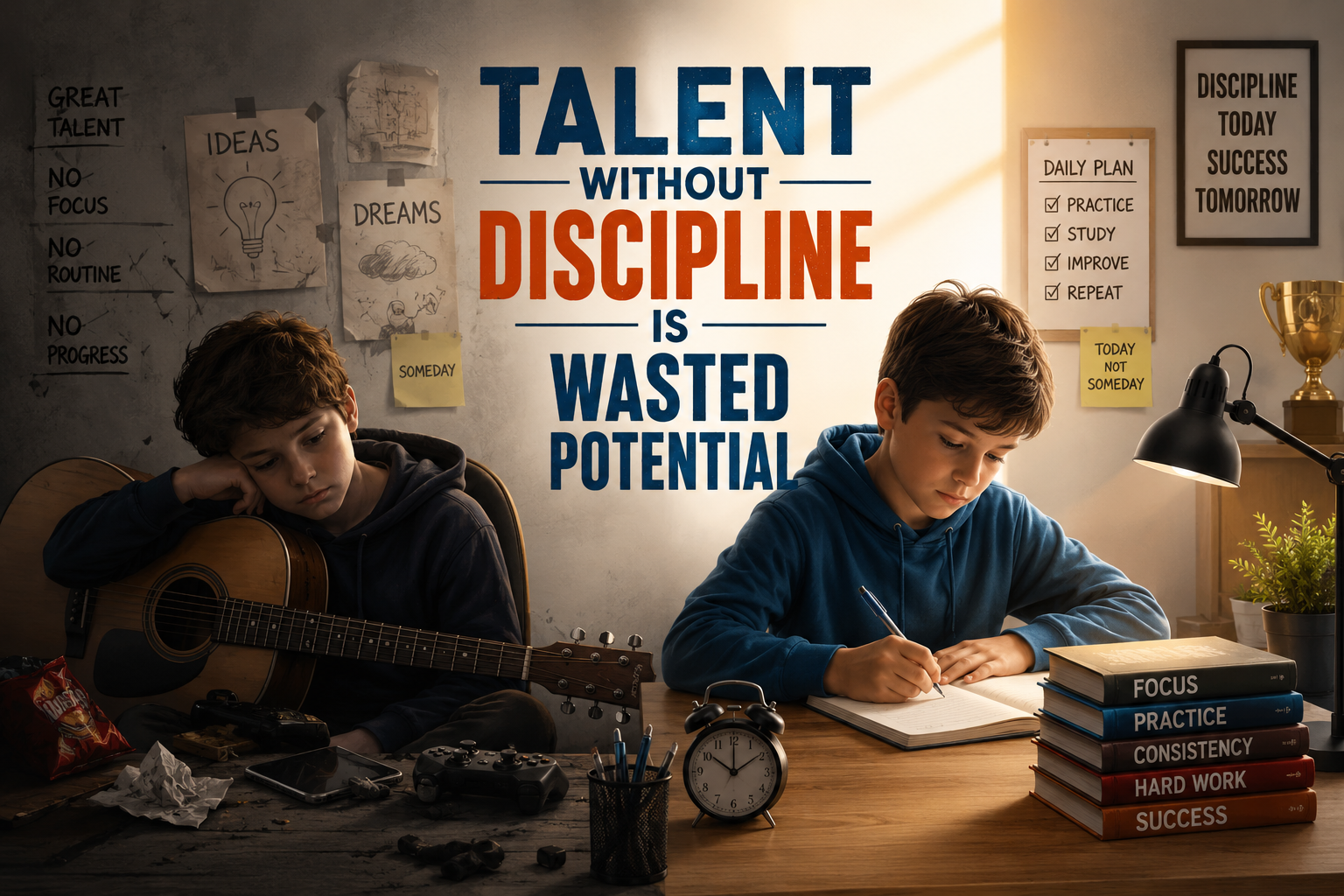
“Hard work beats talent when talent doesn’t work hard.” — Tim Notke
Somewhere right now, a gifted child is being told she has a natural gift for music. A young man is being praised for his brilliance without ever being asked how hard he worked. A promising athlete is being celebrated for raw speed rather than for the countless hours spent refining technique. We live in a culture that is dazzled by talent — and that dazzle, more often than not, becomes a trap.
The uncomfortable truth that parents, educators, and mentors must speak aloud is this: talent, on its own, is nothing more than a starting advantage. It is potential energy — stored, dormant, and utterly dependent on the one force that can convert it into something real. That force is discipline.
Without discipline, talent withers quietly. And the tragedy is that the talented rarely see it coming.
The Gift That Becomes a Liability
There is a particular danger in being told you are gifted too early and too often. When a child’s identity becomes fused with their talent — when being “the smart one” or “the talented one” becomes who they are — the child begins to protect that identity rather than develop it.
Psychologist Carol Dweck spent decades studying this phenomenon. Her research showed that children praised for intelligence rather than effort tend to avoid challenges because failure threatens their self-image. The gifted child who coasted through primary school on natural ability arrives at secondary school, encounters real difficulty for the first time, and — lacking the discipline muscle that other students developed through struggle — simply stops. Not because they lack intelligence, but because they never learned to persist.
Talent, paradoxically, can make you fragile. Discipline makes you durable.
“Talent is cheaper than table salt. What separates the talented individual from the successful one is a lot of hard work.” — Stephen King
What Discipline Actually Is
We often confuse discipline with punishment or rigid self-denial. In reality, discipline is something far more generous: it is the systematic conversion of potential into ability, and ability into mastery.
Discipline is showing up when you do not feel like it. It is doing the unglamorous work — the drills, the drafts, the revisions, the early mornings — that never makes it into the highlights reel. It is choosing the long return over the quick reward. It is, in short, the willingness to close the gap between who you are and who you are capable of becoming.
In thirty years of working with young people, one pattern repeats itself without exception: the students who achieve the most are rarely the most naturally gifted. They are the ones who learned — often through failure — to keep going. They are the ones who built routines, honored commitments, and returned to the work even when the work was hard.
The Stories We Don’t Tell
We celebrate the prodigy. We rarely tell the full story.
Wolfgang Amadeus Mozart is held up as the supreme example of natural genius — and indeed, he was extraordinary. But his father Leopold was a professional musician who began formal training when Wolfgang was barely three years old. By the time Mozart composed his first acknowledged masterwork at twenty-one, he had logged an estimated twenty years of intensive practice. The genius was real. So was the discipline that shaped it.
Michael Jordan, widely considered the greatest basketball player of all time, was cut from his high school varsity team. He responded not with resentment but with an almost monastic dedication to improvement. His talent was considerable. His discipline was legendary. It was the second that made him the first.
The story of talent alone — unaccompanied by the story of effort — does a disservice to everyone who hears it. It suggests that greatness is bestowed rather than built. It discourages the less-naturally-gifted and gives the more-naturally-gifted a dangerous excuse to coast.

“We are what we repeatedly do. Excellence, then, is not an act, but a habit.” — Will Durant, paraphrasing Aristotle
What Wasted Potential Looks Like
Wasted potential rarely announces itself dramatically. It does not arrive with a single catastrophic failure. It accumulates quietly, in small daily surrenders.
It looks like the gifted writer who never finishes a manuscript because the first draft is never as brilliant as the idea in his head. It looks like the talented student who discovers that her intelligence, which once made everything easy, no longer compensates for the preparation she never learned to do. It looks like the promising young professional who plateaus early because she relied on charm and natural ability rather than developing the craft of her discipline.
By the time wasted potential is visible, years have passed. Opportunities have narrowed. And the person is left with the most painful of all burdens: the knowledge of what they could have been.
How to Honor Your Talent
Honoring your talent does not mean celebrating it. It means serving it — which requires something much harder.
Build practice, not just a performance. The visible moments — the concert, the match, the presentation — are where talent is displayed. But talent is developed in private, in the unglamorous repetition of fundamentals. Create daily practice and protect it fiercely.
Embrace difficulty as information. The moment something feels hard is not a sign that you lack talent. It is a sign that you have arrived at the edge of your current ability — precisely where growth happens. Talented people who avoid difficulty stop growing. Disciplined people who seek it compound.
Measure effort, not just outcome. Track what you do, not only what you achieve. On any given day, outcomes are partially outside your control. Your effort, your consistency, your willingness to return to work, these you can control completely.
Surround yourself with people who work. Environment shapes behavior more than most of us are comfortable admitting. If you are the hardest worker in your circle, your standard will drift downward toward the group norm. Seek those whose discipline challenges and raises your own.
A Final Word
Talent is a gift. Discipline is a choice. The gift is given once; the choice must be made every day.
The world has never been short of talented people. History is littered with the names of those who had every natural advantage and achieved very little, and it is illuminated by those who had modest gifts and made something extraordinary of them through sheer, sustained effort.
If you have been given talent — in any domain, in any measure — you have been given responsibility. Not to display it, but to develop it. Not to protect it, but to stretch it. Not to rest on it, but to build on it, day by day, through the quiet, unglamorous, transformative work of discipline.
Potential is not a destination. It is a direction. Discipline is what moves you along with it.