

Sibling relationships are among the longest-lasting relationships people experience in life. Brothers and sisters often share childhood memories, family traditions, celebrations, and challenges. When nurtured positively, these relationships become a lifelong source of love, support, and companionship. However, sibling rivalry, competition, and jealousy are common in many families. Children may compete for attention, compare achievements, or become resentful when they perceive that a sibling receives more affection or recognition.
While occasional disagreements are a normal part of growing up, constant competition and jealousy can damage self-esteem, create emotional distance, and affect family harmony. Parents play the most important role in shaping healthy sibling relationships. By encouraging cooperation, fairness, empathy, and mutual respect, they can help children develop bonds that grow stronger with time rather than weaker.
Understanding Why Sibling Jealousy Develops
Sibling jealousy usually arises from a child’s perception that love, attention, or opportunities are limited. Young children naturally seek approval from their parents. When they believe a brother or sister is receiving more affection, praise, or privileges, feelings of insecurity may emerge.
Several situations commonly trigger sibling rivalry:
- Comparing academic or athletic performance.
- Differences in age or abilities.
- Unequal responsibilities or privileges.
- Competition for parental attention.
- Favoritism, whether real or perceived.
- Major family changes such as the birth of a new baby.
It is important to remember that jealousy is a natural emotion. The goal is not to eliminate it completely but to teach children how to manage it in healthy and constructive ways.
Avoid Comparisons Between Children
One of the quickest ways to create rivalry is through constant comparison.
Statements such as:
“Why can’t you be as organized as your sister?”
or
“Your brother always finishes his homework on time.”
may appear harmless, but they unintentionally send the message that one child is more valuable than another.
Every child possesses unique strengths, interests, and talents. Instead of comparing siblings, compare each child only with their own previous performance.
For example:
“You worked much harder on this project than you did last time.”
This approach encourages personal growth rather than unhealthy competition.
Celebrate Individual Strengths
Children flourish when they are appreciated for who they are instead of how they measure up against someone else.
One child may excel in mathematics, another in music, while another may be exceptionally kind or creative. Every ability deserves recognition.
Parents should regularly highlight each child’s unique qualities.
For example:
- “You are very thoughtful when helping others.”
- “You have wonderful artistic ideas.”
- “You solve problems very patiently.”
When children understand that every family member contributes something valuable, they become less likely to compete for the same form of recognition.
Give Every Child Individual Attention
Children often compete because they crave their parents’ attention.
Even spending fifteen to twenty minutes alone with each child can make a significant difference. During this time, avoid distractions and allow the child to choose the activity.
Whether reading a story, playing a game, going for a walk, or simply talking, individual attention reassures children that they are equally loved and valued.
Quality matters far more than quantity.
Teach That Love Is Unlimited
Young children sometimes believe love works like a pie—if one sibling receives a larger slice, there is less left for everyone else.
Parents should repeatedly remind children that parental love is not divided; it is multiplied.
Simple affirmations such as:
“I love each of you completely, even though I love you differently because each of you is unique.”
help children develop emotional security.
Feeling secure reduces the need to compete for affection.
Encourage Teamwork Instead of Competition
Many family activities unintentionally promote competition.
Instead of always organizing contests where one child wins and another loses, create opportunities for siblings to work together.
Examples include:
- Building a puzzle together.
- Baking cookies as a team.
- Planting a garden.
- Cleaning a room together.
- Completing a family treasure hunt.
When children experience success through cooperation, they begin to view each other as teammates rather than rivals.
Parents should praise collaborative efforts more than individual victories.
Teach Empathy
Empathy enables children to understand another person’s feelings.
Whenever conflicts arise, encourage each child to consider the other’s perspective.
Ask questions such as:
- “How do you think your sister felt when that happened?”
- “What would you feel if someone treated you that way?”
- “How could you make your brother feel better?”
These conversations gradually develop emotional intelligence and reduce selfish behavior.
Children who understand another person’s emotions are less likely to intentionally cause hurt.
Avoid Labeling Children
Labels often become self-fulfilling.
Comments such as:
- “She’s the smart one.”
- “He’s the naughty one.”
- “You’re the athletic child.”
- “She’s the quiet one.”
may appear descriptive, but they can trap children into fixed roles.
One child may feel pressure to maintain the label, while another may believe they can never measure up.
Instead, recognize behaviors rather than identities.
For example:
“You worked very hard today.”
rather than
“You’re the clever one.”
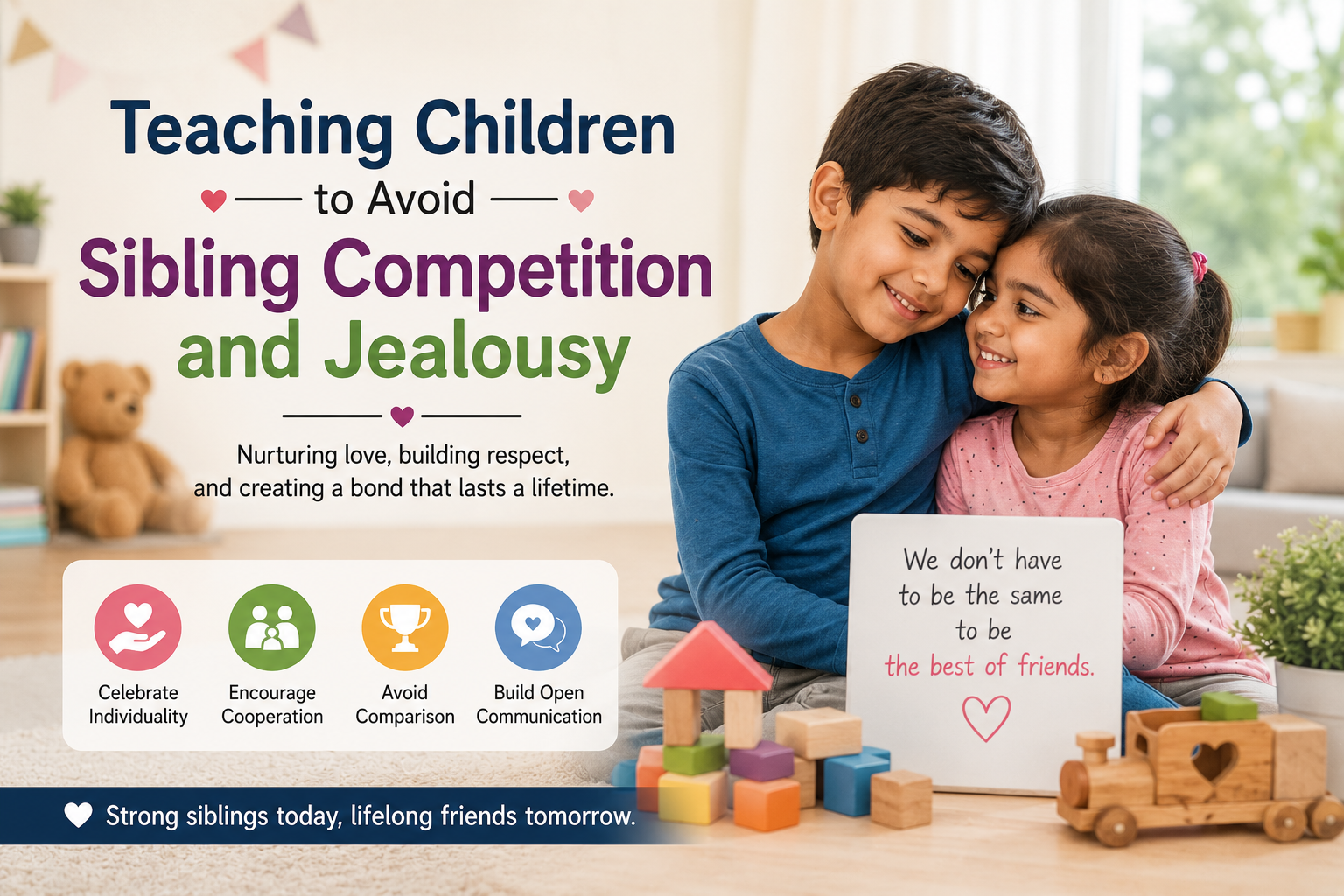
Teach Gratitude Instead of Comparison
Jealousy grows when children constantly focus on what others have.
Gratitude shifts attention toward appreciating one’s own blessings.
Encourage children to share something they are thankful for each day.
Family gratitude discussions during dinner or bedtime help children develop positive thinking.
A grateful child spends less time envying others and more time appreciating what they already possess.
Handle Conflicts Fairly
Parents should avoid acting as judges who immediately decide who is right and who is wrong.
Instead, become coaches who help children solve problems.
Allow each child to explain their perspective without interruption.
Guide them toward finding solutions together.
Ask:
- “How can we solve this fairly?”
- “What can each of you do differently next time?”
This approach teaches responsibility, negotiation, and respect.
Model Respectful Relationships
Children learn far more from observation than instruction.
If parents frequently criticize, compare, or argue disrespectfully, children are likely to imitate those behaviors.
Demonstrating kindness, patience, forgiveness, and respectful communication provides children with powerful examples.
When parents apologize after making mistakes, children also learn humility and accountability.
Encourage Celebrating Each Other’s Success
Teach children that another person’s success does not diminish their own.
When one sibling achieves something, encourage the others to celebrate.
Whether it is winning a competition, earning excellent grades, or learning a new skill, family members should congratulate and encourage one another.
Parents can model this by expressing genuine excitement for each child’s accomplishments.
Celebrating success together strengthens family unity instead of encouraging envy.
Help Children Solve Problems Together
Whenever siblings face disagreements, avoid solving every problem for them.
Instead, guide them through a structured conversation:
- Listen to each person’s perspective.
- Identify the problem.
- Brainstorm possible solutions.
- Agree on a fair solution.
- Evaluate whether it worked.
Over time, children become better at resolving disagreements independently and respectfully.
Create Family Traditions That Promote Unity
Shared experiences strengthen sibling bonds.
Simple traditions such as family game nights, weekend outings, storytelling sessions, cooking together, or volunteering as a family create positive memories.
These experiences remind children that they belong to the same team.
Strong family identity naturally reduces unhealthy competition.
Final Thoughts
Sibling competition and jealousy are natural parts of childhood, but they do not have to define family relationships. With patience, consistency, and intentional parenting, children can learn to appreciate one another’s strengths, celebrate each other’s achievements, and resolve conflicts with empathy and respect.
Parents who avoid comparisons, provide individual attention, encourage cooperation, and model kindness create an environment where every child feels secure and valued. Over time, siblings begin to understand that love is not something they must compete for—it is something they can freely share.